

How Torque Limiting Wedgelocks Work: A 2LM Design Deep Dive
Wedgelock installation torque has to land in a narrow window. Under-torque it and clamping force and thermal contact both suffer. Over-torque it and you risk damaging the card, the chassis slot, or the wedgelock itself. Hitting that window has historically depended on a calibrated torque wrench and a trained technician, neither of which is guaranteed in the field. Torque Limiting SOLIDWEDGE™ wedgelocks take a different approach.
What Problem Does Torque Limiting Solve?
Historically, getting wedgelock installation torque right has depended on two things being available at the same time, a calibrated torque wrench and a technician trained to use it correctly. Losing either one causes problems.
- Requiring a calibrated tool: A calibrated torque wrench is required to hit the correct clamping force, and field environments don't always have one on hand or in calibration.
- Requiring trained technicians: Even with the right tool, hitting correct torque depends on training, and field rotations and technician turnover mean that training isn't always in place when a card needs to be swapped.
- Under-torquing: Insufficient clamping force means poor thermal contact at the wedgelock-to-cold wall interface, and reduced retention under shock and vibration.
- Over-torquing: Excess force risks damaging the card, the chassis slot, or the wedgelock hardware itself.
In a controlled depot environment, this is manageable. In a field environment, on a ship, in an aircraft, or at a forward operating base, technicians may not have a calibrated tool on hand and may not have received that training. Torque Limiting SOLIDWEDGE™ wedgelocks are a mechanical advancement on that historical dependency, moving torque control off the tool and the technician and into the wedgelock itself.
How Does Torque Limiting Work in a Wedgelock?
Torque Limiting SOLIDWEDGE™ wedgelocks use a patent-pending slip clutch ratchet built into the drive mechanism. As the drive screw is turned to expand the wedgelock, the clutch transmits torque normally, right up until the wedge segments reach the correct clamping force. At that point, the clutch slips instead of continuing to transmit torque into the mechanism.
To achieve a calibrated slip torque, each torque drive head is precisely assembled on automated equipment, then broken in and tested against that specific target value before it leaves the factory.
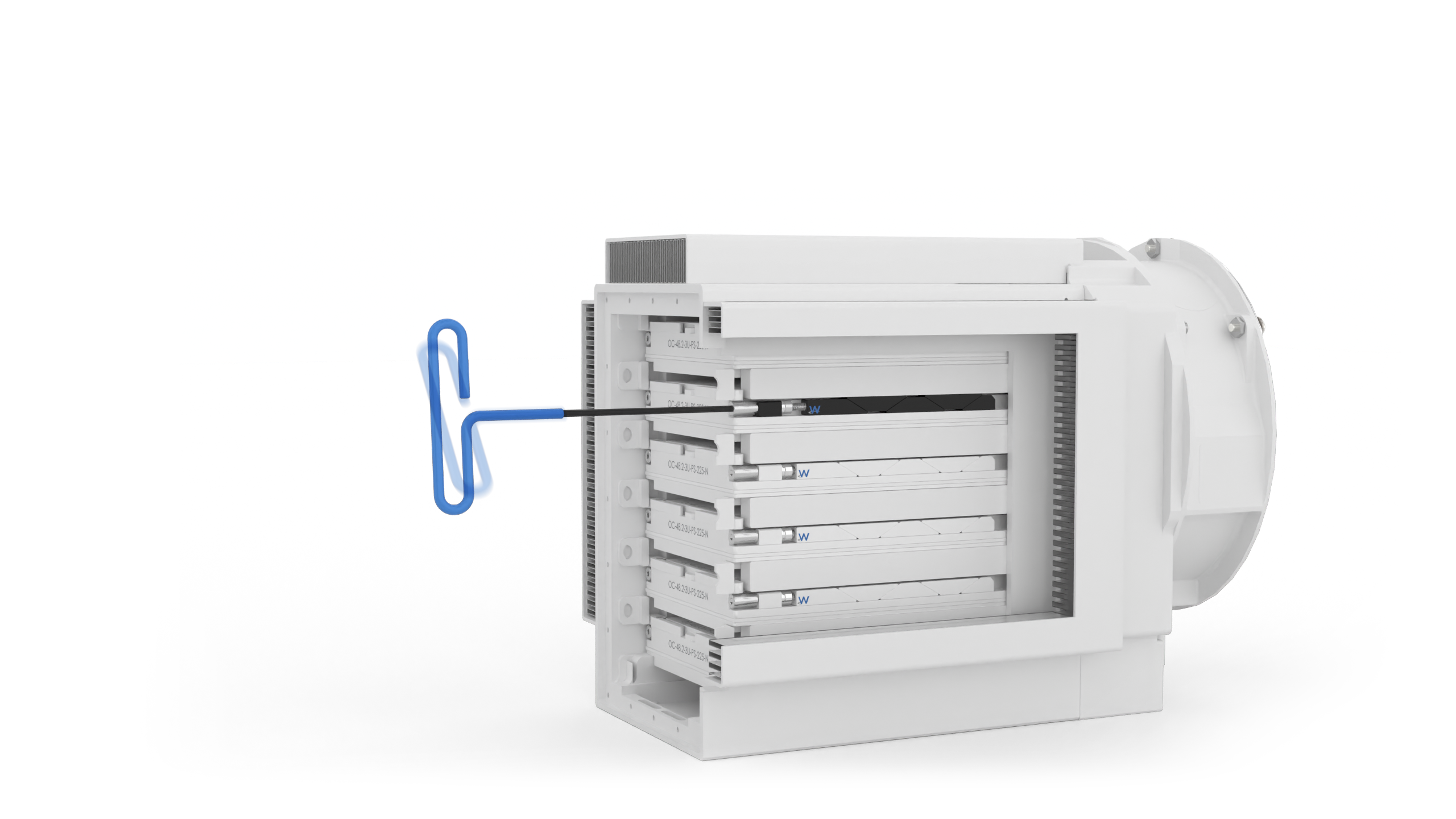
Practically, this means the wedgelock self-limits at the correct clamping force automatically. Once the target torque is reached, the mechanism produces an audible click and a tactile response the technician can feel through the tool, instead of letting the drive screw turn any further. That confirms the install is complete and correctly torqued without reading a gauge or checking a spec sheet mid-install. There's no torque wrench required, no calibration step, and no dependence on the technician's judgment to know when to stop.
Cutaway animation of a Torque Limiting SOLIDWEDGE™ wedgelock slip clutch ratchet mechanism engaging during installation.
Why Torque Limiting Only Works in One Direction
The slip clutch only limits torque during expansion, when the wedgelock is being installed. On removal, turning the drive screw in reverse delivers full, unrestricted torque.
This directional behavior is intentional. The purpose of torque limiting is to prevent over-tightening on install, not to restrict the force available for extraction. Full-force retraction also works together with SOLIDWEDGE™'s positive retraction design, where every wedge segment is mechanically linked to the drive screw so segments are pulled back rather than just released. A wedgelock that limited torque in both directions would risk the same stuck, jammed module that positive retraction is designed to prevent.


Torque limited expansion (left) versus full force retraction (right).
Why Torque Limiting Matters for Two-Level Maintenance (2LM)
Two-Level Maintenance collapses the traditional three-level maintenance model, organizational, intermediate, and depot, into two levels, field-level and sustainment-level. In practice, that means a technician working directly on a ship, aircraft, or forward operating base can pull a failed circuit card and swap in a replacement without shipping the whole unit back to a depot facility.
2LM only works if the mechanical hardware actually supports it. That means wedgelocks that release reliably without jamming, no specialized tooling requirement, proper ESD protection built into the module, and an installation process a field technician can execute without specialist knowledge. Torque limiting addresses that tooling requirement directly. VITA 48.2 (VPX-REDI) formally calls out 2LM compatibility as a mechanical design requirement for conduction-cooled VPX modules, and torque limiting wedgelocks are built specifically to satisfy it.
Does Torque Limiting Sacrifice Mechanical Performance?
No. Torque Limiting SOLIDWEDGE™ wedgelocks are built on the same solid segment design and positive retraction mechanism as standard SOLIDWEDGE™ wedgelocks. Adding the slip clutch ratchet to the drive mechanism doesn't change the clamping geometry, the thermal cross-section, or the segment design that provides shock and vibration performance. A correctly torqued Torque Limiting wedgelock holds a card just as securely under shock and vibration as a standard SOLIDWEDGE™ wedgelock torqued to the same specification with a calibrated tool.
Torque Limiting vs. a Torque Wrench: What Changes in the Field
With a standard wedgelock, correct installation torque depends on having a calibrated torque wrench on hand, keeping that tool's calibration current, and trusting the technician to read and apply it correctly under whatever conditions they're working in. Torque limiting removes that dependency entirely. The correct torque is enforced by the wedgelock's own drive mechanism, so a standard hand tool is all that's needed and there's nothing to calibrate or verify beforehand.
That also removes the training burden that comes with calibrated tools. There's no calibration equipment to maintain and no specialized torque procedure to teach, so a technician who has never worked on a particular card before can still install its wedgelocks correctly on the first attempt, even in high-tempo field environments where toolkits are already incomplete.
What This Means for Your VPX Design
If your system needs to meet 2LM requirements under VITA 48.2, or if field technicians will ever install or replace conduction-cooled cards without depot-level support, wedgelock installation torque is a design decision, not just an installation detail. Torque Limiting SOLIDWEDGE™ wedgelocks are available across the SOLIDWEDGE™ size range, so specifying torque limiting doesn't mean giving up the clamping force or thermal cross-section your thermal budget already requires.
Browse WaveTherm's Torque Limiting wedgelock collection to find the right configuration for your application.
